
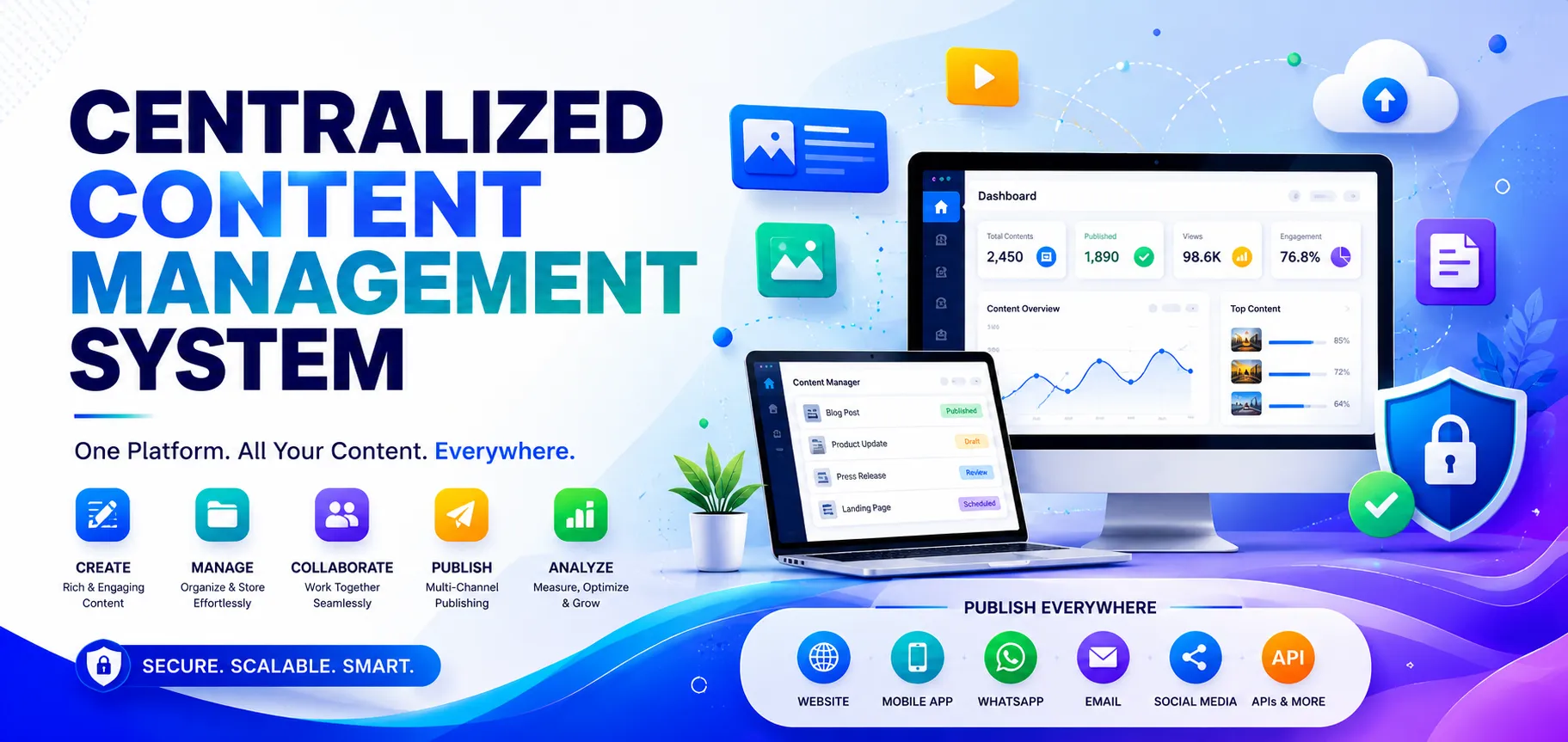
In today's digital-first world, organizations create and manage vast amounts of content every day. From website pages and blog articles to marketing campaigns, product catalogs, social media posts, and mobile app content, keeping everything organized can quickly become challenging. This is where a Centralized Content Management System (CCMS) becomes a game-changer.
A Centralized Content Management System allows businesses to create, manage, store, approve, and publish content from a single platform. Instead of maintaining separate systems for different channels, organizations can streamline content operations, improve collaboration, and ensure consistency across all digital touchpoints.
A Centralized Content Management System is a software platform that serves as a single source of truth for all organizational content. It enables teams to create, edit, review, store, and distribute content from one centralized location.
Whether your business manages multiple websites, mobile applications, e-commerce stores, marketing campaigns, or customer portals, a CCMS helps ensure that content remains accurate, updated, and consistent everywhere it appears.
Unlike traditional content management systems that focus primarily on website publishing, a centralized system supports multi-channel content delivery and enterprise-level content governance.
Many organizations struggle with content scattered across multiple platforms, spreadsheets, folders, and databases. This often leads to:
Duplicate content creation
Inconsistent branding
Outdated information
Inefficient workflows
Increased operational costs
Difficulty tracking content performance
A centralized CMS solves these challenges by providing one platform where all content-related activities take place.
One of the most important features is a unified content library. All content assets, including articles, images, videos, documents, and marketing materials, are stored in a centralized location.
Benefits include:
Easy content discovery
Reduced duplication
Better organization
Improved accessibility
Teams can quickly locate and reuse existing content instead of creating new versions repeatedly.
Modern CCMS platforms provide user-friendly content editors that allow content creators to:
Write articles
Create landing pages
Manage product descriptions
Design marketing campaigns
Many systems also include AI-assisted content generation tools that help improve productivity and content quality.
Content often requires multiple levels of review before publication. A centralized CMS streamlines this process through automated workflows.
Typical workflow stages include:
Draft
Review
Approval
Publication
Archive
This ensures content accuracy and compliance while reducing manual coordination efforts.
Different users require different permissions. A centralized CMS allows administrators to assign roles such as:
Administrator
Editor
Author
Reviewer
Marketing Manager
Role-based access improves security and prevents unauthorized modifications.
Managing digital assets can be difficult without proper organization. A centralized CMS includes a media library where users can:
Upload images
Store videos
Manage documents
Organize assets using folders and tags
This helps maintain brand consistency across all channels.
Version control allows organizations to track content changes over time.
Benefits include:
Content history tracking
Easy rollback options
Audit trail maintenance
Reduced risk of accidental content loss
This feature is especially valuable for enterprises handling large volumes of content.
A modern centralized CMS supports search engine optimization through:
Meta title management
Meta descriptions
URL customization
XML sitemap generation
Schema markup integration
These features help improve search engine visibility and organic traffic.
Understanding content performance is essential for business growth.
Built-in analytics can provide insights into:
Page views
User engagement
Conversion rates
Traffic sources
Content effectiveness
Organizations can use this data to optimize content strategies and improve ROI.
A centralized platform enables teams from different departments to work together efficiently.
Content creators, editors, designers, marketers, and administrators can collaborate within a single system, reducing communication gaps and project delays.
Maintaining a consistent brand voice is crucial across websites, social media, email campaigns, and mobile applications.
A centralized CMS ensures that approved content and digital assets are accessible to all teams, reducing inconsistencies.
Automation features such as workflows, approvals, content scheduling, and asset management help teams work faster and more efficiently.
Employees spend less time searching for content and more time creating value.
Organizations can implement strict access controls, audit logs, and approval workflows to ensure content security and regulatory compliance.
This is especially important in industries such as healthcare, finance, education, and government.
As businesses grow, content requirements increase.
A centralized CMS can scale to support:
Multiple websites
Multiple languages
Global teams
Enterprise-level content operations
This makes it a future-proof investment.
One of the biggest advantages of a centralized CMS is the ability to publish content across multiple channels from a single source.
Channels may include:
Corporate websites
Mobile applications
E-commerce platforms
Social media networks
Email marketing campaigns
Customer portals
Partner APIs
WhatsApp communications
This approach ensures content consistency while reducing management complexity.
Hospitals and clinics use centralized CMS platforms to manage:
Patient education materials
Doctor profiles
Service information
Marketing content
Educational institutions can centralize:
Course information
Student resources
News updates
Event announcements
Online stores benefit from centralized management of:
Product descriptions
Images
Promotions
Marketing campaigns
Large organizations use centralized CMS solutions to manage content across departments, regions, and business units.
The future of content management is becoming increasingly intelligent and automated. Modern CCMS platforms are incorporating technologies such as:
Artificial Intelligence (AI)
Machine Learning
Content Personalization
Predictive Analytics
Automated Content Recommendations
Voice Search Optimization
These innovations help organizations deliver better user experiences while reducing operational effort.
A Centralized Content Management System is no longer a luxury—it is a necessity for organizations managing content across multiple digital channels. By providing a single platform for content creation, storage, approval, and distribution, a CCMS improves efficiency, enhances collaboration, strengthens security, and ensures consistent brand communication.
Whether you are a small business, educational institution, healthcare provider, or large enterprise, implementing a centralized CMS can transform the way your organization manages and delivers content. As digital ecosystems continue to expand, businesses that adopt centralized content management solutions will be better positioned to scale, innovate, and engage their audiences effectively.
A well-designed Centralized Content Management System is not just a content repository—it is the foundation of a modern digital content strategy.
Leadership, Finance, Operations, Growth, Product, Service, Sales, Marketing